
Google Maps' Hidden Costs: A Deep Dive into Its Backend Monetization Strategy
Discover the hidden costs behind Google Maps' free consumer experience and how businesses pay for its backend services in 2026.
LazyFounders
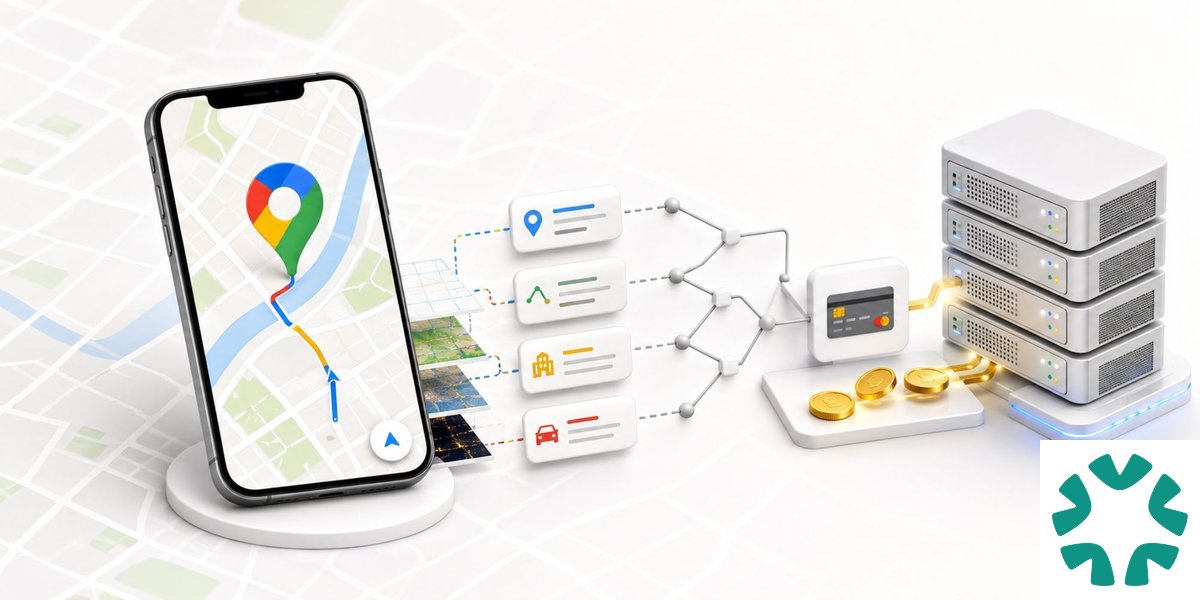

Google Maps' Hidden Costs: A Deep Dive into Its Backend Monetization Strategy
30 SEC SUMMARY
Google Maps offers a free consumer experience, but businesses using its backend services face hidden costs. From map loads to place searches, every request is billed separately, with some services costing significantly more than others. This monetization strategy builds trust and habit among consumers while generating substantial revenue for Google.
TABLE OF CONTENTS
- Introduction
- Google Maps' Pricing Model
- Real-World Cost Examples
- The Silent Cost of Autocomplete
- Recent Pricing Changes
- Why Nobody Notices the Business
- Google's Revenue Reporting
- The Bigger Picture
- FAQs
- Conclusion
- Call-to-Action
Introduction
Google Maps is a ubiquitous tool that offers a free consumer experience. However, behind the scenes, businesses face hidden costs for using its backend services. This article delves into Google Maps' monetization strategy and how it impacts businesses in 2026.
Google Maps' Pricing Model
Google Maps Platform bills developers on a pay-as-you-go basis, priced per SKU rather than per product. Published rates range from $2 per 1,000 calls for Static Maps to $40 per 1,000 for the most feature-rich Places lookups. Each SKU carries its own monthly free cap, with Essentials-tier services capped at 10,000 calls, Pro at 5,000, and Enterprise at 1,000.
Real-World Cost Examples
For a property platform serving 100,000 listing views a month, where each view loads a map, a Street View panel, a place detail lookup, and a geocode, the monthly cost is roughly $3,300. A logistics operation running 500 drivers, generating around 300,000 monthly calls each across maps, routing, geocoding, and route optimization, lands near $6,000 a month.
The Silent Cost of Autocomplete
The sharpest edge in the pricing model is Places Autocomplete. Used correctly, autocomplete is nearly free. A session token groups every keystroke a user types into a single session, all of those requests bill at zero, and only the terminating place lookup is charged. However, used without a session token, or with one that has expired or been reused, each keystroke becomes its own billable request at $2.83 per 1,000.
Recent Pricing Changes
Google has restructured pricing twice in under a year. On March 1, 2025, it retired the flat $200 monthly credit every account received, replaced it with per-SKU free caps, reorganized services into Essentials, Pro, and Enterprise categories, and moved Places API, Directions API, and Distance Matrix API to Legacy status. Later in the year, it layered optional fixed-price subscription plans on top: Starter at $100 a month, Essentials at $275, Pro at $1,200.
Why Nobody Notices the Business
None of this billing touches the consumer experience. When you check directions in the Google Maps app, you are using the free consumer product. When a ride-sharing app, a real estate marketplace, or a restaurant locator shows you a map inside their own app, you are looking at output from an entirely different, metered product that their business is paying for behind the scenes, per request, in real time, as you scroll.
Google's Revenue Reporting
Google does not report Maps revenue as its own line item. Alphabet's FY2024 10-K splits Google Services into Search & other, YouTube ads, Google Network, and Google subscriptions, platforms and devices, the last of which brought in $40.34 billion. Maps Platform fees are never named. The most reasonable reading is that they sit inside that final catch-all, but Alphabet has never confirmed it and has never indicated the size of the business.
The Bigger Picture
Google Maps is a clean example of a pattern that now runs through most of consumer tech: a free consumer product functions as the on-ramp, building trust, habit, and ubiquity, while a separate metered B2B product monetizes every company that wants to build on top of that trust.
FAQs
What are the hidden costs of Google Maps for businesses?
The hidden costs include per-request billing for map loads, place searches, and other services, with some services costing significantly more than others.
How does Google Maps' pricing model impact businesses?
Businesses face substantial costs for using Google Maps' backend services, especially for high-volume operations.
What recent changes has Google made to its Maps pricing?
Google restructured its pricing in 2025, replacing flat credits with per-SKU free caps and introducing optional fixed-price subscription plans.
Conclusion
Google Maps' hidden costs reveal a broader monetization strategy that leverages free consumer products to build trust and habit, while generating substantial revenue from metered B2B services. Understanding these costs is crucial for businesses relying on Google Maps in 2026.
Call-to-Action
For more insights into tech monetization strategies, visit blogy.in.
Sources
This story is an original summary and analysis written by LazyFounders from the reporting listed above. Facts are attributed to their original publishers; sections marked as analysis are LazyFounders's opinion. Where a source is in another language, facts were machine-translated and quotations are reported, not reproduced. Read the original coverage via the links.