
UPI MDR 2026: Government's Plan to Charge Fees on Digital Payments
In 2026, the Indian government plans to introduce Merchant Discount Rate (MDR) on UPI transactions. Learn about the implications and who might benefit from this change.
LazyFounders

UPI MDR 2026: Government's Plan to Charge Fees on Digital Payments
30 SEC SUMMARY
In 2026, India's government is set to introduce Merchant Discount Rate (MDR) on Unified Payments Interface (UPI) transactions. This move aims to create a sustainable revenue model for banks and payment companies while addressing the rising costs of maintaining UPI. However, it raises concerns about how this will impact consumer behavior and the overall frictionless experience of digital payments.
TABLE OF CONTENTS
- Introduction
- The Economics of UPI
- The US Angle
- Who Feels the Pinch?
- Winners of MDR
- Conclusion
- Call-to-Action
KEY HIGHLIGHTS
- The Indian government plans to introduce MDR on UPI transactions in 2026.
- The move aims to create a sustainable revenue model for banks and payment companies.
- There is concern about how MDR will impact consumer behavior and the frictionless experience of digital payments.
- The US Trade Representative has flagged India’s zero-MDR policy as a potential barrier for foreign payment networks.
Introduction
In the last decade, UPI has revolutionized how India transacts. Initially designed as a simple, instant, and interoperable way to transfer money, UPI has become an integral part of everyday life. However, almost a decade into its journey, the government has opened the legal door to charging a Merchant Discount Rate (MDR) on some UPI transactions, raising numerous questions.
The Economics of UPI
The economics of UPI have always been slightly unusual. The network has grown at an extraordinary pace, but the primary transaction rail has remained effectively free. UPI transactions have carried zero MDR for nearly 10 years, meaning payment aggregators, banks, and other ecosystem participants cannot charge merchants for processing most UPI payments.
This worked beautifully when the priority was adoption. But adoption is no longer a hurdle. UPI processed 2,366 Cr transactions in July, up from 2,272 Cr in June. Transaction value rose to ₹29.88 Lakh Cr from ₹28.92 Lakh Cr during the same period.
While UPI now accounts for around 60-65% of the transaction volume passing through payment aggregators, under the current zero-MDR regime, that means a significant chunk of the industry’s transaction volume generates no direct revenue.
The US Angle
The government’s move to create a legal framework for charging MDR on UPI and RuPay transactions has brought another factor into the debate: US trade pressure. According to trade policy experts, the Trump administration has repeatedly pushed trading partners to ensure a “level playing field” for US companies operating in digital markets.
That has put India’s zero-MDR regime under scrutiny. In its March 2026 report on foreign trade barriers, the US Trade Representative (USTR) flagged India’s zero-MDR policy for UPI and RuPay as a potential barrier that could disadvantage foreign payment networks. The concern is particularly relevant for US payment giants such as Visa and Mastercard, which operate under a fee-based model and compete with India’s largely free UPI infrastructure.
Who Feels the Pinch?
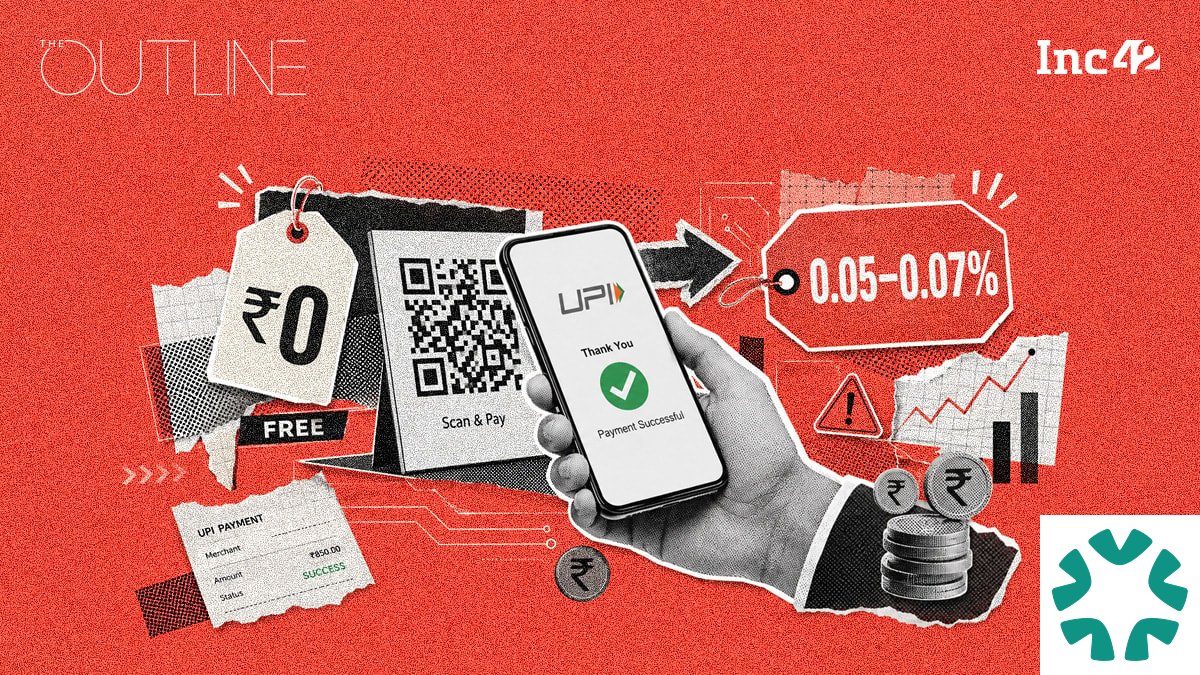
The proposed MDR framework reportedly targets larger merchants with annual turnover of around ₹1-1.5 Cr or more, charging a 0.05%-0.07% fee on UPI transactions above ₹2,000.
The idea is to keep India’s smallest merchants and the bulk of low-value transactions outside the charging framework while monetizing a relatively narrow slice of UPI.
While card payments in India have historically carried an MDR of around 1.8%, a 0.05%-0.07% MDR on UPI may look negligible on paper. But consumers don’t think like this. They think about whether a payment is free or not.
A Local Circles survey, which received more than 45,000 responses from 322 districts, found that 53% of respondents said they would move away from UPI for transactions above ₹3,000 if MDR were imposed on large merchants. Of those, 27% said they would switch to credit cards, 14% to debit cards, and 12% to bank transfers or cash.
Winners of MDR
With MDR, enterprise-focused payment aggregators could finally monetize a substantial portion of the transaction volume they currently process without a direct fee. Banks could also get a better return on the infrastructure investments they have been making to support the ever-growing UPI volumes.
Smaller technology-led players could potentially find it easier to compete because they would no longer be operating in a market where a significant part of the payment value chain earns zero transaction revenue.
But the consumer-facing third-party apps, including PhonePe, Google Pay, Paytm, Amazon Pay, Navi, super.money, may not be the primary beneficiaries. These apps already derive revenue from other parts of the payment ecosystem and are not necessarily dependent on charging users for every UPI transaction. So, if MDR is introduced, the money may flow primarily towards the bank and payment aggregator layers, rather than directly transforming the business models of UPI apps.
Conclusion
The introduction of MDR on UPI transactions in 2026 aims to create a sustainable revenue model for banks and payment companies while addressing the rising costs of maintaining UPI. However, it raises concerns about how this will impact consumer behavior and the overall frictionless experience of digital payments. The government now faces the tricky balancing act of ensuring sustained investment in infrastructure, cybersecurity, and fraud prevention without disrupting the consumer habit that made UPI so successful.
Call-to-Action
For more insights on digital payments and the latest industry trends, visit blogy.in.
Sources
- inc42.com · 2026-08-09
UPI’s Free Ride Is Over
This story is an original summary and analysis written by LazyFounders from the reporting listed above. Facts are attributed to their original publishers; sections marked as analysis are LazyFounders's opinion. Where a source is in another language, facts were machine-translated and quotations are reported, not reproduced. Read the original coverage via the links.