
Pioneering India's Industrial Future: Pre-1947 Business Leaders
Discover the pre-1947 business leaders who shaped India's industrial future. Explore seven influential books detailing the lives and legacies of Jamsetji Tata and others.
LazyFounders

Pioneering India's Industrial Future: Pre-1947 Business Leaders
30 SEC SUMMARY
Delve into the lives of India's pre-1947 industrial pioneers through seven insightful books. These works explore the visionary leaders like Jamsetji Tata and G.D. Birla who laid the foundations of modern Indian industry under colonial rule.
TABLE OF CONTENTS
KEY HIGHLIGHTS
- Detailed biographies of Jamsetji Tata and other industrial pioneers
- Insight into the challenges faced under colonial rule
- Evolution of Indian capitalism before 1947
- The role of family, networks, and trust in business growth
- Broader historical context of Indian business development
Introduction
Before India gained independence in 1947, a remarkable group of entrepreneurs laid the foundations of the country's industrial and commercial future. Operating under colonial rule, these visionaries built businesses in sectors ranging from textiles and steel to shipping, aviation, and manufacturing. Their achievements were not merely commercial successes; they were acts of nation-building that created jobs, infrastructure, and confidence in Indian enterprise.
For the Love of India
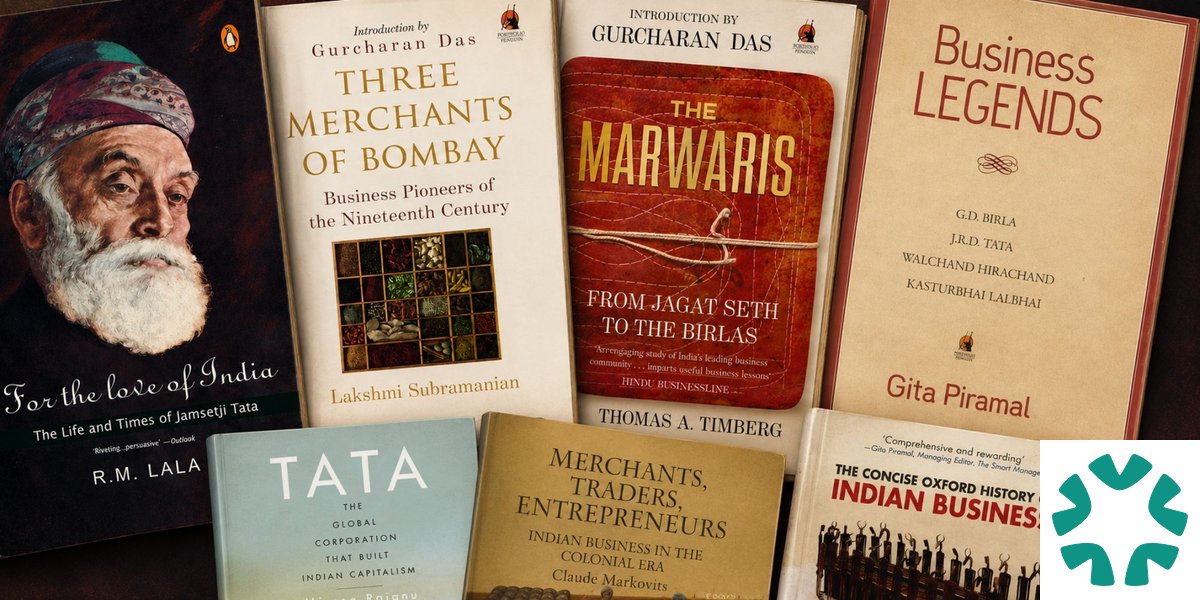
For the Love of India: The Life and Times of Jamsetji Tata by R.M. Lala is an essential starting point for anyone interested in India’s early industrial pioneers. The book explores the life of Jamsetji Nusserwanji Tata, who imagined an India with its own industrial strength, scientific institutions, and modern infrastructure.
Lala presents Tata as a businessman who understood that successful enterprise required long-term thinking. His interests in steel, power, scientific research, and education reflected an unusually broad vision for his time. The book also gives readers a sense of the obstacles involved in attempting to build large-scale Indian industries under colonial rule.
Three Merchants of Bombay
Three Merchants of Bombay: Business Pioneers of the Nineteenth Century by Lakshmi Subramanian moves away from the better-known industrial narratives and focuses on the commercial world of nineteenth-century Bombay.
The merchants featured in the book operated in a world shaped by expanding global trade, colonial institutions, and changing patterns of finance. Their success depended on their ability to understand markets, establish trusted relationships, and work across commercial networks.
The Marwaris
The Marwaris: From Jagat Seth to the Birlas by Thomas A. Timberg explores the history of one of India’s most influential business communities. Rather than focusing on one entrepreneur, the book traces the development of Marwari commercial networks and their eventual transition from trading into large-scale industry.
The history is particularly valuable because it demonstrates that the growth of Indian business was closely connected to migration, community relationships, and systems of trust. Marwari traders established themselves in different parts of the country and developed networks that allowed them to conduct business across considerable distances.
Business Legends
Business Legends by Gita Piramal brings together the stories of several major Indian entrepreneurs and business families, making it particularly useful for readers who want to compare different approaches to building businesses.
The book looks at individuals who played important roles in shaping Indian enterprise and examines the qualities, decisions, and circumstances that contributed to their success. Its strength lies in placing business leaders within the broader context of the Indian economy rather than presenting their achievements as isolated stories.
Tata: The Global Corporation
Tata: The Global Corporation That Built Indian Capitalism by Mircea Raianu offers a more analytical examination of the Tata enterprise and its place in the development of Indian capitalism.
Rather than treating the Tata story simply as a biography of Jamsetji Tata, Raianu examines how the group evolved into an institution with a distinctive approach to corporate organization, management, and social responsibility. The historical perspective is particularly valuable when examining the period before independence.
Merchants, Traders, Entrepreneurs
Merchants, Traders, Entrepreneurs: Indian Business in the Colonial Era by Claude Markovits provides a wider historical framework for understanding Indian business before 1947.
Instead of concentrating only on famous industrialists, the book examines the broader network of merchants, traders, and entrepreneurs who participated in India’s economic life during the colonial period. The book explores the relationships between Indian business communities, colonial institutions, and wider international markets.
The Oxford History of Indian Business
The Oxford History of Indian Business by Dwijendra Tripathi is an excellent choice for readers who want to move beyond individual biographies and understand the larger evolution of Indian enterprise.
Tripathi examines the development of Indian business across different periods, communities, and sectors. The book provides context for the emergence of merchant groups, industrial entrepreneurs, and major business houses and places their growth within the changing economic and political environment of India.
Why These Books Matter
The history of India’s pre-1947 business pioneers is much more than a collection of stories about wealthy industrialists. It is a history of experimentation, adaptation, and institution-building under difficult circumstances. These seven books reveal different dimensions of that story.
For the Love of India brings Jamsetji Tata’s extraordinary vision to life. Taken together, these books show that India’s business story did not begin with independence. The foundations were already being laid through trading communities, industrial experiments, family enterprises, and ambitious institutions long before 1947.
For readers who want to understand how Indian enterprise evolved, these books offer more than business lessons. They reveal how entrepreneurs operated within a changing society and how their decisions helped shape the economic foundations of modern India.
Conclusion
The pre-1947 business leaders of India laid the groundwork for the nation's industrial future. Through their vision, resilience, and innovative strategies, they created a legacy that continues to influence Indian business today. These seven books provide invaluable insights into their lives and the broader context of India’s economic development.
FAQ
What makes For the Love of India special?
For the Love of India offers a deeply human biography of Jamsetji Tata, connecting his personal ambition with his vision for a strong, independent India.
How does The Marwaris differ from other books on Indian business?
The Marwaris focuses on the development of Marwari commercial networks and their transition from trading to large-scale industry, highlighting the role of migration and community relationships.
Why is The Oxford History of Indian Business important?
The Oxford History of Indian Business provides a comprehensive view of Indian business development across different periods, communities, and sectors, placing entrepreneurs within larger transformations in trade, industry, finance, and economic policy.
Call-to-Action
Explore the fascinating stories of India’s pre-1947 business leaders by visiting blogy.in. Dive deep into the history that shaped modern India’s industrial landscape.
Sources
This story is an original summary and analysis written by LazyFounders from the reporting listed above. Facts are attributed to their original publishers; sections marked as analysis are LazyFounders's opinion. Where a source is in another language, facts were machine-translated and quotations are reported, not reproduced. Read the original coverage via the links.